Episode #69: Aligning Product Work with Your Values with Sowmya Subramanian
Sowmya Subramanian explains how curiosity, customer access, clear goals, and mission alignment shaped her path into climate-focused product management.

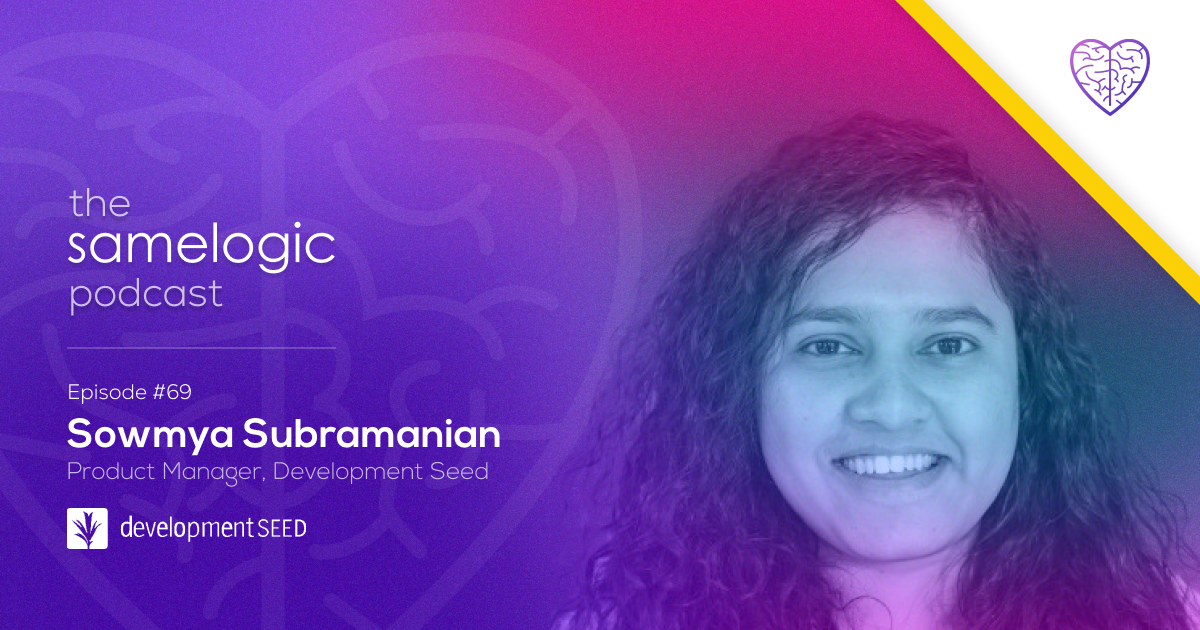
Sowmya Subramanian did not begin her career with the product manager title, but she was already drawn to product questions. As a software engineer, she wanted to know why a team was building something, what value it offered, and whom it served. The questions were useful, but the people around her were often focused on implementation rather than the business context she wanted to understand.
She moved into business analytics and management consulting, then found a nonprofit role whose title evolved from business analyst to organizational excellence analyst. The daily work included leading voice-of-customer efforts, helping shape product concepts, taking them to market, and connecting a three-year business strategy to a portfolio of products. That experience gave her a name for the work she had been seeking. When she next changed jobs, she could describe both her skills and her desired role more directly: product management.
What you'll learn
How recurring questions can reveal the role you are already trying to perform
Why customer access changed Sowmya's experience of product work
How to keep distributed, client-facing teams aligned without rigid Scrum
What to ask before committing technical effort to a proposed solution
How personal values can guide a search for mission-aligned product work
Keep the problem visible across projects
At Development Seed, Sowmya works across geospatial technology projects involving subjects such as climate, open science, humanitarian needs, and machine learning. The company often builds with clients and partners rather than owning a single SaaS product from beginning to end. Team members are distributed across India, Europe, the United States, and New Zealand, so she starts by catching up through Slack and GitHub before preparing for a meeting-heavy morning.
The operating model is what she calls Scrum-light. People cannot always be dedicated to one product, and the client may own the project and the closest relationship with end users. Her job is therefore less about enforcing a ceremony and more about maintaining clarity. She asks what the team needs from the client, whether users or clients have reviewed recent work, and whether feedback has arrived within the last few weeks. Show-and-tell sessions help preserve an iterative rhythm when direct access varies.
That clarity matters because a technical request can hide an unresolved product problem. A client might ask for a machine-learning model that detects houses. Sowmya responds with questions: Why must houses be detected? In which geography? Is the problem local or global? Is this a one-time snapshot, continuous monitoring, or a before-and-after comparison following an intervention? The answers affect scope, budget, and whether the requested model is even the right use of resources.
A useful practice is to restate the desired outcome whenever development enters the details. Ask whether the current task still serves that outcome. If it does not, the team can revise, deprioritize, or remove it before technical momentum turns an assumption into an expensive commitment.
Use access and learning to shape your path
Sowmya contrasts her early experience at Tata Consultancy Services with her work at ASQ. At Tata, a large client engagement involved many people, layers of command, and information barriers. While working on systems related to a merger between car-rental companies with different business models, she could deliver the assigned feature but struggled to reach someone who could explain the larger reason for it.
At the midsize nonprofit ASQ, she could speak with leaders, volunteers, members, and the board. That access nurtured her voice-of-customer practice and customer empathy. She also studied Lean and became certified in Six Sigma, partly to understand the value that ASQ's members gained from those methods. Rather than treating an unfamiliar domain as a barrier, she became a version of the customer and learned from inside the experience.
She carries that approach into newer fields. When joining Development Seed, she was transparent about not having a deep geospatial or open-source background. She paired that honesty with evidence that she had researched the company and a willingness to keep learning from technical colleagues. When teammates introduced GPT-3 for possible project use, she followed her questions into language models, alternatives, and the reason the technology might fit.
Align work with values, then ask with purpose
Sowmya's interest in sustainability grew from an attempt to live more minimally. Research helped her see that replacing usable possessions with supposedly sustainable alternatives could itself create waste. Climate anxiety increased, especially during the rise in disposable products around COVID, and she concluded that individual practices alone were not the scale of response she wanted. She began looking for organizations where her product work could support climate and humanitarian outcomes.
Development Seed combined technology, climate-related work, humanitarian applications, and geospatial data. The fit connected professional growth with personal values, but it did not remove the fast pace or ambiguity of product work. Sowmya says she thrives in change because she can bring structure to chaos without requiring a manual or several layers of permission for every decision.
Her advice to her younger self is to keep asking questions, but attach them to a goal. Decide what you want from a conversation and consider why the other person should invest time in answering. That turns curiosity from an open-ended habit into a tool for mutual value and better decisions.
Listen to Episode #69 for Sowmya Subramanian's full discussion of product questions, distributed teamwork, learning, and mission-aligned work.
Continue with the workflow pages
Use the ideas from this episode inside the selector, Playwright, and bug-reproduction pages that connect content to product intent.
 Install the Chrome Extension